ETA you can actually
promise.
Freightglint factors the lane, the carrier's real on-time history, and live weather — so your operations team has a delivery window they can stand behind, not a carrier estimate they have to pad by two hours.
The freight ETA problem
of inbound ops calls are WISMO — "where's my load?" — a call your team has to field manually, every time.
Carriers self-report on-time performance 15 percentage points above actual measured OTP on many lanes.
3PLs manually hedge ETA windows by 2–4 hours as a buffer, destroying the precision their customers need.
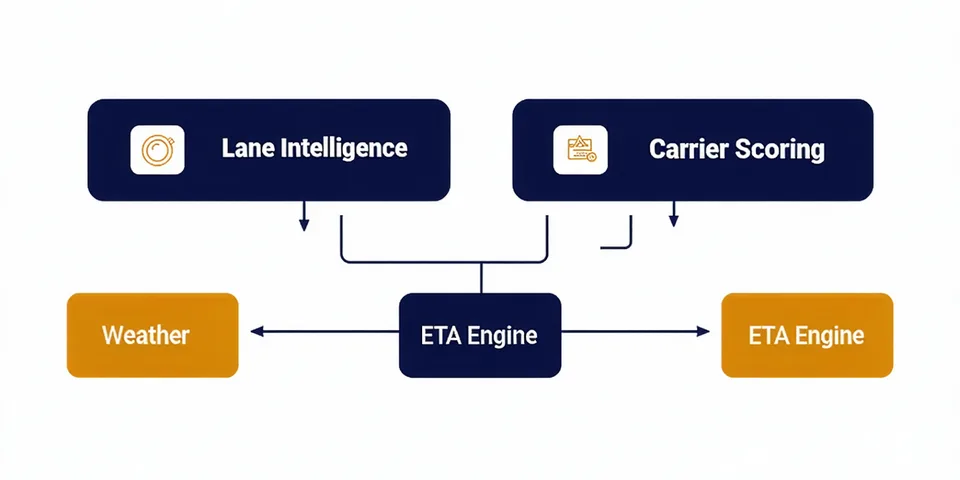
Four inputs. One prediction your ops team can use.
Freightglint builds each ETA from the data sources that actually determine whether a load arrives on time — not from what the carrier reported at booking.
Lane Intelligence
Historical OTP indexed by carrier × lane × season × day-of-week. 6M+ pairs. Surfaces which specific routes perform — not what a carrier's network average claims.
Carrier Scoring
Rolling 90-day OTP index per carrier per lane — not a static contract rating. A carrier with 12% late-rate growth in the past month gets a wider confidence band, not the same score as six months ago.
Weather Overlay
NOAA forecast correlated against historical delay patterns per corridor. Weather contributes an estimated 15–25% of unplanned delay variance on FTL lanes — and carrier booking ETAs never factor it in.
ETA Engine
Weighted model output with a confidence band and specific risk flags — weather, carrier OTP deviation, holiday proximity. A window you can quote to customers, not a single point estimate you'll miss by 90 minutes.
Numbers from early customers in the US truckload corridor
These figures are from early customer observation periods and are not certified benchmarks.
Real ops impact. Profile names withheld per standard logistics NDA practice.
"Before Freightglint, our ops team spent 90 minutes every morning calling carriers to confirm ETAs on loads that picked up the night before. We cut that in half within 60 days — now we review exceptions, not dial-for-ETAs."
"We had a gut sense that one carrier was underperforming on our DFW–OKC lane. The lane-level scoring confirmed it — 31% late on that specific corridor — and gave us the data to justify the routing change. Improvement showed up inside a month."
Stop padding windows.
Start quoting times you can stand behind.
30-minute demo on your actual lanes. Bring 90 days of load history and we'll show you what Freightglint already knows about your top carrier-lane pairs.
Freightglint · 1722 Routh Street, Suite 1000 · Dallas, TX 75201